
Moving art: tips for paintings, pictures and sculptures when you move
Artworks are often among the most delicate household items to move. Careful documentation, suitable packing materials and a few moving-day precautions can help reduce the risk of damage. This guide covers what to consider when moving paintings, framed pictures, sculptures and antiques.
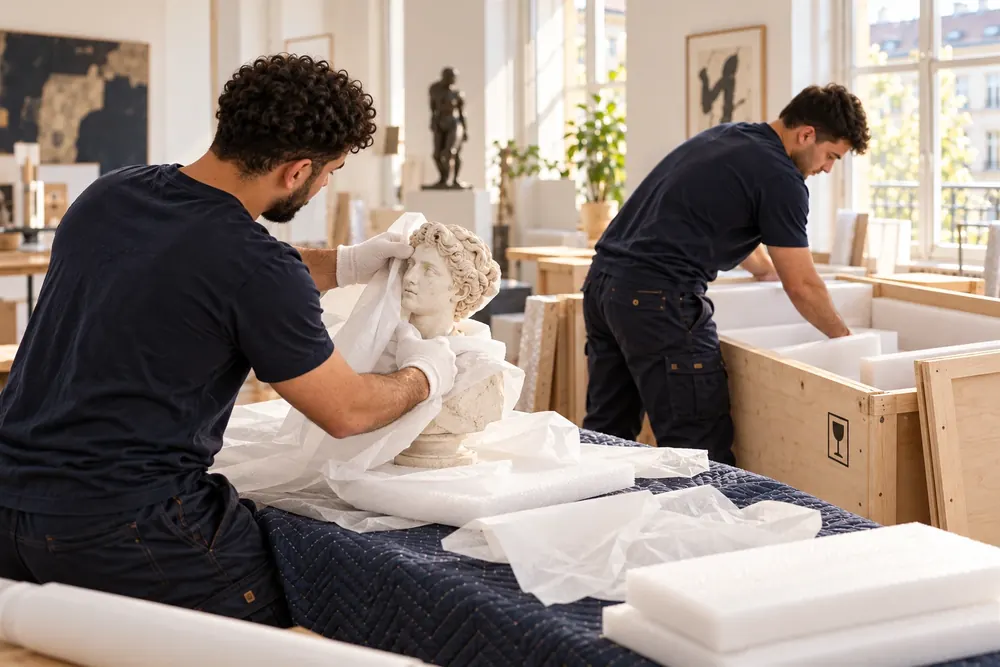
In short
- Paintings and framed pictures are transported standing on their edge, not stacked flat.
- Stretch wrap should never go directly on a paint layer or frame, because it traps moisture and can stick.
- Acid-free paper, not newspaper, is the right first layer on delicate surfaces.
- The value and insurance cover of an artwork should be clarified with your own insurer before the move.
How do I prepare artworks for a move?
The most important work happens before the first box is packed: if you document the condition and clarify the value, you can prove any damage later and make decisions without rushing.
1.Document the condition with photos
Photograph each piece from the front, the back and at the corners. Record existing scratches, cracks or loose areas in close-ups so that the condition before the move is clearly documented.
2.Draw up a simple inventory list
Note the title, dimensions, material and the room the piece will go to in your new home. Number boxes and crates to match the list.
3.Clarify value and insurance beforehand
Check with your own insurer whether, and up to what amount, artworks are covered during the move. For valuable pieces, an appraisal by an expert may be worthwhile.
4.Inform the moving company in good time
Tell them in advance which artworks are coming, how large and heavy they are, and what is especially delicate. For very valuable or fragile pieces, a specialist fine-art shipper may be the right choice.
5.Check hangers and loose parts
Inspect hangers, wires and hooks. Removable parts such as bases or top pieces are packed separately and labelled.
How do I pack paintings and framed pictures properly?
The rule for packing is: from the inside out. First a soft, smooth layer protects the surface, then come padding and a sturdy outer shell.
1.Acid-free paper as the first layer
Cover the surface with acid-free paper or smooth, unprinted paper. Newspaper is unsuitable because the ink can rub off.
2.No stretch wrap directly on the work
Stretch wrap applied directly to the paint layer or frame traps moisture and can stick to the surface. If wrap is used at all, it should only be the outermost layer over paper and padding.
3.Protect the corners with corner guards
Frame corners are where damage happens most often. Corner guards made of cardboard or foam absorb knocks to the corners.
4.Tape a cross on the glass
On glazed pictures, apply a cross of masking tape to the glass only, not to the frame or the work. If the glass breaks, the shards are more likely to stay in place. Remove the tape promptly after the move.
5.Soft padding, firm enclosure
Pad with bubble wrap (bubbles facing outwards), blankets or foam, and place the picture in a suitably sized picture box. For valuable or large works, a sturdy crate with internal padding, in which nothing can shift, is the safer solution.
6.How we pack at Paradiso Umzüge
When we move artwork for you, we pack it in wrapping paper, bubble wrap and boxes, the same materials we also offer as packing supplies. On top of that, we protect each piece with foam and air-cushion packaging.
How do I move sculptures and antiques?
Three-dimensional objects are weakest at their thin and protruding parts. They need packaging that supports the object all around.
1.Protect protruding parts individually
Wrap thin or projecting parts such as arms, points or handles separately in tissue paper and padding first, before packing the whole object.
2.Fill all empty spaces
Nothing should be able to move inside the box or crate. Fill gaps with padding so that the object stays firmly in place even if it is tilted.
3.Carry heavy objects by the base
Lift sculptures at their most stable point, usually the base or body, never by protruding parts. Heavy pieces should be carried by two people.
4.Take care of antique furniture and surfaces
Delicate surfaces such as polish or veneer are protected with blankets, not directly with wrap or tape. Secure drawers and doors without sticking tape onto the surface.
5.Label clearly
Mark every crate with “Fragile” and “This way up”, along with the number from your inventory list.
What matters on moving day?
Even well-packed art can be damaged during loading and driving. A few firm rules reduce the risk considerably.
1.Transport pictures upright
Paintings and framed pictures stand on their edge during transport, separated from one another by padding. Stacked flat, the weight presses down on canvas and glass.
2.Don't put anything on top
Nothing is placed on top of art crates or picture boxes. In the vehicle, they are secured with straps so they don't slide when braking.
3.Avoid heat, cold and moisture
Don't leave artworks in the vehicle, in full sun or in the rain for long. Sharp changes in temperature and humidity put strain on canvas, wood and paint layers.
4.Last on, first off
Artworks go into the vehicle last and come out first. That way they are not in the way and spend as little time on the road as possible.
What should I keep in mind after the move?
1.Let it acclimatise
If the art was moved in cold weather, keep the packaging closed for a while so that the piece slowly adjusts to room temperature and no condensation forms.
2.Unpack carefully and inspect
Never cut packaging close to the surface. Compare the condition with your photos and document any new damage straight away.
3.Choose the right place to hang it
Choose wall anchors and hooks to suit the wall and the weight. Don't hang art above radiators, in direct sunlight or on damp exterior walls.
Common mistakes
Stretch wrap directly on the work. Wrap on a paint layer or frame traps moisture and can leave marks.
Newspaper as packing material. Printing ink can rub off onto canvas, works on paper and light-coloured frames.
Stacking pictures flat. The weight of the pictures on top presses on the canvas and glass of those below.
No photos before the move. Without documentation, it is hard to prove later whether damage is new.
Sorting out value and insurance afterwards. Whether a work is covered should be settled before transport, not after something has been damaged.
Tape on frames or surfaces. Adhesive can damage gilding, varnish and paint; tape belongs only on glass and packaging.
Lifting sculptures by protruding parts. Arms, points and handles are the weakest spots and break most easily.
Unpacking art straight away after a cold journey. The rapid change in temperature can cause condensation on the surface.
Checklist before moving day
- Every artwork photographed from all sides, existing damage recorded in close-up
- Inventory list drawn up with title, dimensions, material and destination room
- Value and insurance cover clarified with your own insurer
- Moving company informed of the number, size and fragility of the works
- Acid-free paper, corner guards, bubble wrap, blankets and picture boxes ready
- Glass secured with a tape cross, frames and surfaces kept free of tape
- Sculptures packed in filled crates, with fragile parts padded separately
- All crates labelled “Fragile”, “This way up” and with their inventory number
- Space planned in the vehicle where pictures can travel upright and secured
- New hanging spot chosen away from radiators, direct sunlight and damp walls
Frequently asked questions
What is the safest way to transport paintings when moving?
Paintings are covered with acid-free paper, fitted with corner guards, softly padded and packed in a suitable picture box or a sturdy crate. In the vehicle, they stand upright on their edge and are secured against slipping.
Can I put stretch wrap directly on a picture?
No. Stretch wrap applied directly to the paint layer or frame traps moisture and can stick to the surface. If wrap is used at all, it only goes on as the outermost layer over paper and padding.
How do I secure the glass of a framed picture?
Apply a cross of masking tape to the glass, not to the frame or the work. If the glass breaks, the shards are more likely to stay in place. The tape should be removed promptly after the move.
How do I pack a sculpture for a move?
Thin and protruding parts are padded individually first, then the whole object. All empty spaces in the crate are filled so that nothing can move. The sculpture is carried by its base or body, never by protruding parts.
Are my artworks automatically covered during the move?
That depends on your policy. Clarify the value and insurance cover of your artworks with your own insurer before the move, and have valuable pieces appraised by an expert if needed.
Why shouldn't I unpack art straight away after the move?
After transport in cold weather, condensation can form on the surface if you unpack too quickly. So keep the packaging closed for a while until the piece has adjusted to room temperature.
A free quote for your move.
Request a quote online in a few steps or call us directly. We also speak Turkish.